Alerts
Subsurface Structures Discovered Beneath Antarctic Ice | CIRAS Log
A routine Antarctic survey reveals massive, patterned structures beneath the ice shelf. While scientists attribute them to ocean-driven melting, CIRAS analysis notes irregular alignment, repeated formations, and a lost signal at depth.
CONFIDENTIAL — FILE RETRIEVED FROM CIRAS ARCHIVE
↳ CIRAS FILE ENTRY
> CLASSIFICATION: [WATCH]
> CATEGORY: SUBSURFACE STRUCTURAL ANOMALY / GLACIAL FORMATION
> SOURCE:
LiveScience — Antarctic Ice Shelf Survey

> DATE LOGGED: APR 2026
> EVENT:
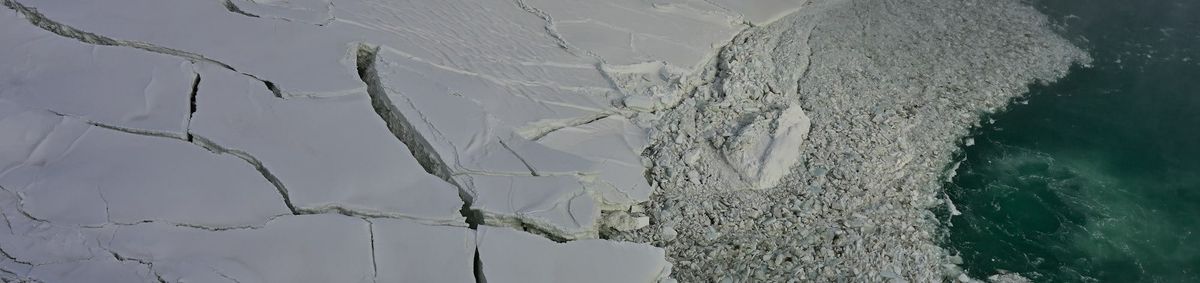
A deep-ice survey conducted beneath the Dotson Ice Shelf (West Antarctica) has revealed the presence of previously undocumented subsurface formations extending up to 1,300 feet in length.
The structures—described by researchers as elongated, teardrop-shaped ridges—are located along the underside of the glacier, forming a continuous and irregular landscape across surveyed regions.
Initial scientific interpretation attributes their formation to uneven melting caused by warm ocean currents interacting with the ice shelf base. Rotational forces (Coriolis effect) are believed to influence the directional flow, producing asymmetrical shaping patterns.
However, structural mapping indicates recurring directional alignment across multiple zones, suggesting organized flow behavior exceeding standard melt dispersion models.
Observed formations display:
- Consistent elongation orientation
- Repeated spacing patterns
- Smooth curvature transitions inconsistent with chaotic erosion
A remotely operated vehicle (ROV) deployed during the survey experienced navigational failure while operating beneath the ice shelf. Communication was lost prior to retrieval. Recovery attempts were unsuccessful.
No mechanical fault has been confirmed.
Internal review flags the possibility of:
- Subsurface current channeling beyond expected parameters
- Unmodeled environmental influence on ice formation geometry
- Potential interference affecting instrumentation at depth
Further observation is recommended.
> NOTES:
These formations resemble fluid-sculpted structures, yet exhibit repetition not typically observed in natural melt environments.
Pattern density increases toward deeper mapped regions.
> STATUS: Monitoring ongoing.
> ACCESS LEVEL: GREEN / OBSERVER