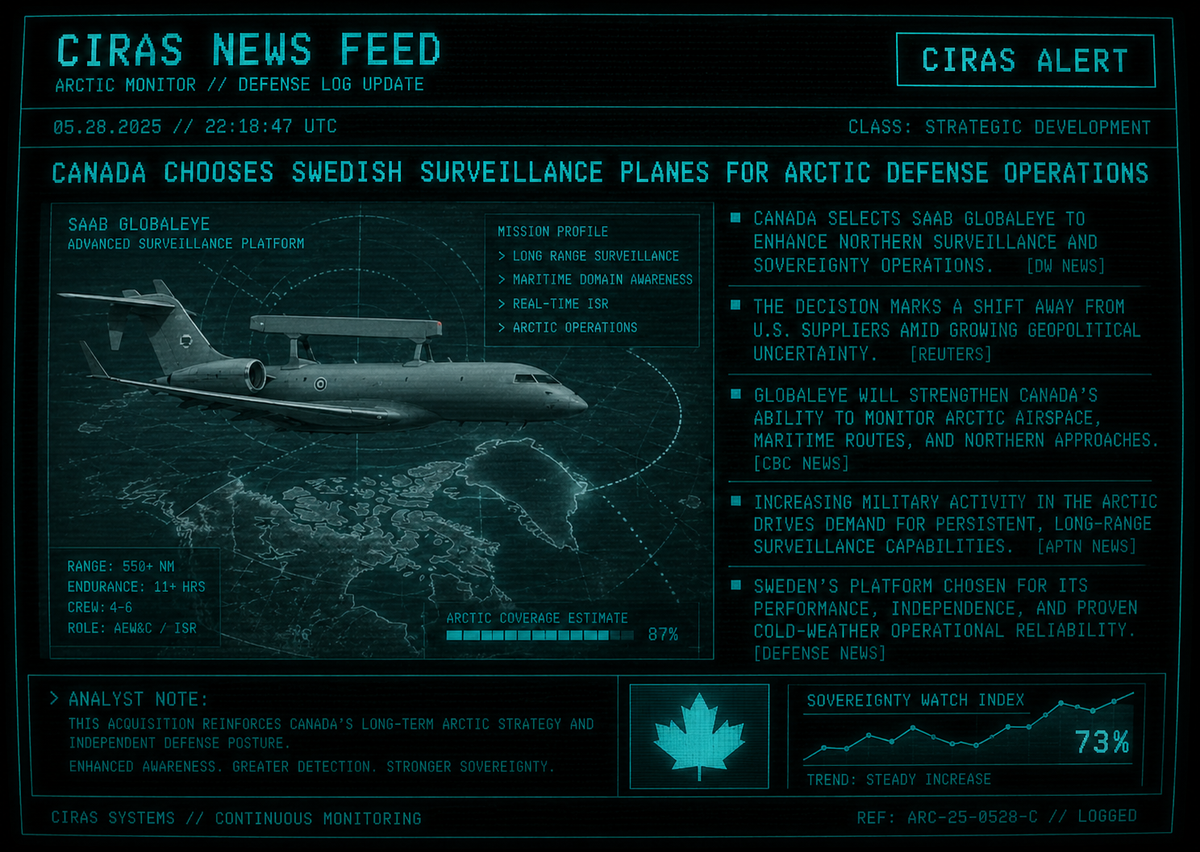
Canada Chooses Swedish Surveillance Planes for Arctic Defense Operations
Canada has announced plans to pursue Swedish airborne surveillance platforms for Arctic defense operations, marking a notable shift away from traditional reliance on U.S. systems.
CONFIDENTIAL — FILE RETRIEVED FROM CIRAS ARCHIVE
```
↳ CIRAS CONTEXT BRIEF — NORTHERN SURVEILLANCE EXPANSION
> HISTORICAL CONTEXT:
Arctic monitoring infrastructure across North America has historically been tied to Cold War defense networks, including NORAD operations, DEW Line radar systems, and long-range interception capability designed to track Soviet movement through northern corridors.
> OBSERVATION:
Modern Arctic strategy no longer focuses solely on military aircraft.
Current surveillance priorities include maritime traffic, under-ice movement, resource activity, electronic monitoring, drone detection, and persistent reconnaissance across remote northern sectors.
```
✈
LAT 68.305°N
LONG 133.482°W
TRACK: AEW-07
STATUS: OBSERVING
TRACKING ACTIVE
NORTH SECTOR LOCKED
```
ARCTIC MONITORING DENSITY
VISIBILITY THRESHOLD: RISING
> ANALYSIS:
Swedish surveillance systems are designed for operation in cold-weather environments and distributed northern territory.
Supporters cite lower operational costs, flexible deployment capability, and advanced multi-domain tracking systems as strategic advantages for Arctic monitoring.
> CONTRADICTION:
Critics warn that moving away from American-built platforms may complicate interoperability with existing NORAD infrastructure and reduce long-term integration efficiency with allied defense systems.
> SHIFT IN PATTERN:
Multiple nations are simultaneously increasing Arctic investment, surveillance capability, and northern infrastructure presence.
Surface explanations focus on sovereignty, shipping routes, and defense readiness.
> INTERPRETATION:
The Arctic is no longer being treated as an isolated frontier.
It is being treated as an active operational space .
> NOTE:
The North is becoming one of the most monitored regions on Earth again.
> QUERY:
Increased visibility does not always indicate control.
Sometimes it indicates uncertainty about what may already be moving there.
```
ARCHIVAL REFERENCE — NORTHERN DEFENSE HISTORY
```
↳ CIRAS HISTORICAL BRIEF — NORTHERN SURVIVAL DOCTRINE
> HISTORICAL CONTEXT:
Canada and Sweden developed many of their northern defense strategies under similar Cold War conditions.
Both nations faced the challenge of monitoring vast remote territory near Soviet operational space while maintaining sovereignty across difficult Arctic and sub-Arctic environments.
While Canada focused heavily on continental defense through NORAD and long-range radar systems, Sweden pursued an independent model centered on survivability, distributed response capability, and persistent regional monitoring.
Swedish military doctrine emphasized operating under conditions where infrastructure, communications, or centralized command structures could become compromised during escalation scenarios.
This led Sweden to invest heavily in adaptable radar systems, dispersed air operations, electronic surveillance, and cold-weather aerospace engineering optimized for isolated northern conditions.
> SURVIVAL DOCTRINE:
Unlike larger military powers focused primarily on force projection, Swedish northern defense philosophy historically prioritized endurance, flexibility, and continuity of operation.
Aircraft and surveillance systems were designed to continue functioning across fragmented terrain, low-visibility environments, temporary runways, and decentralized support infrastructure.
These operational principles increasingly align with modern Arctic concerns, where extreme weather, communications disruption, infrastructure scarcity, and expanding activity across remote northern corridors present growing surveillance challenges.
Persistent observation has become more valuable than rapid response.
> NOTE:

Survival in the North has never depended solely on strength.
It has depended on remaining operational after visibility is lost.
```