Alerts
Antarctica Gravity Anomaly Explained | Earth’s Strongest Gravity Hole & Arctic Effects
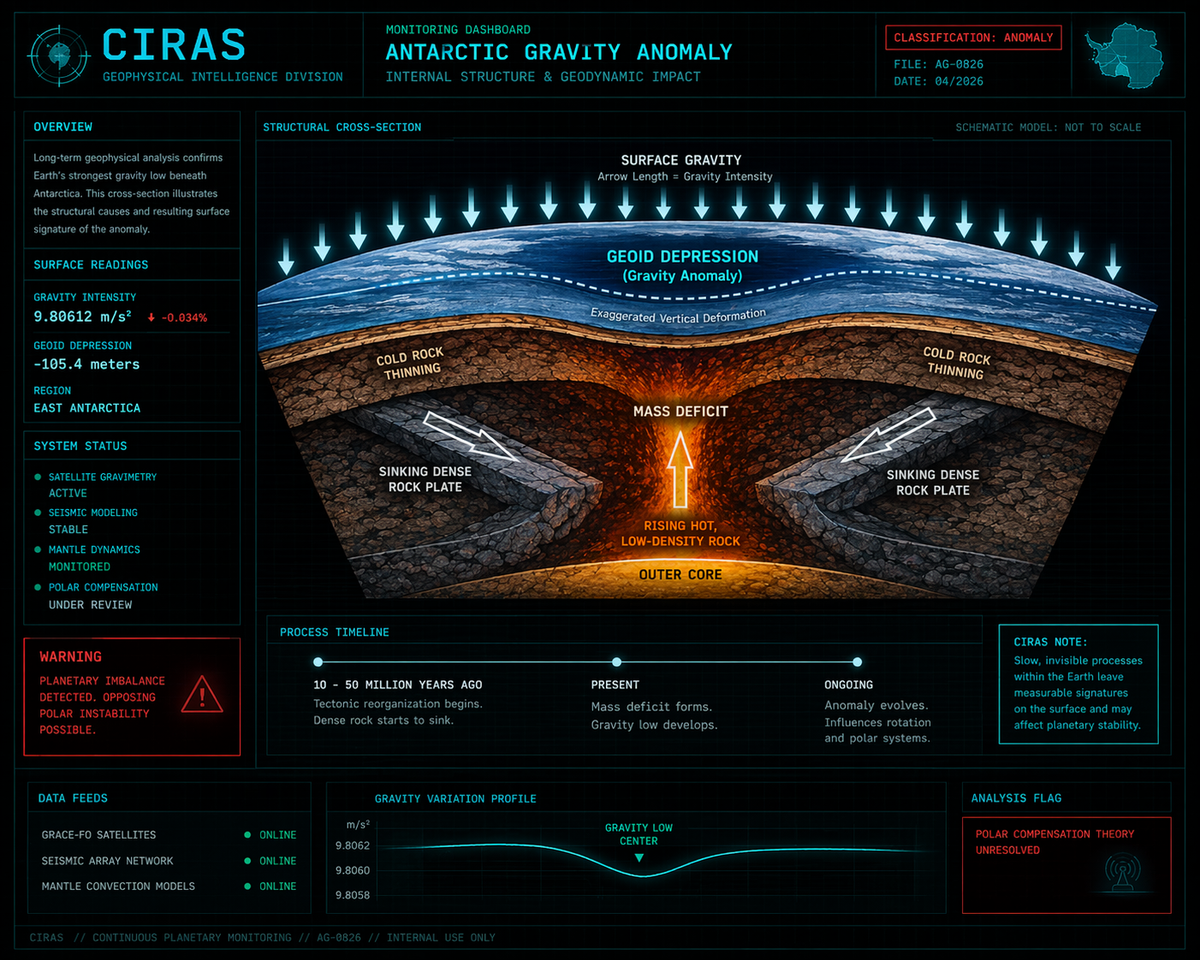
Scientists recently confirmed a massive gravitational anomaly beneath Antarctica — the strongest of its kind on Earth.
But what if this imbalance isn’t isolated?
What if the Arctic is reacting?
CONFIDENTIAL — FILE RETRIEVED FROM CIRAS ARCHIVE
> NEXT FILE: ARCTIC FIELD LOG — SIGNAL RESPONSE BEFORE TRANSMISSION
> STATUS: CORRUPTED
SUPPLEMENTAL FILE — PUBLIC ACCESS FAQ
↳ CIRAS CONTEXT BRIEF
> FILE TYPE: PUBLIC REFERENCE / LIMITED ACCESS
> ACCESS LEVEL: GREEN
What is the Antarctic gravitational anomaly?
A large-scale region beneath Antarctica where Earth’s gravitational field is weaker than expected.
Current models attribute this to deep mantle processes.
CIRAS classification remains under review.
Is this anomaly dangerous?
No direct surface-level hazards have been confirmed.
Secondary effects in opposing polar regions are still being studied.
Why is CIRAS monitoring the Arctic?
Data indicates that large-scale planetary imbalances may produce compensatory effects in distant regions.
The Arctic has shown consistent irregularities across multiple detection systems.
Are time distortions real?
Reported anomalies include inconsistent timestamps and repeated environmental states.
These events are currently classified as observational inconsistencies.
Have similar events been recorded before?
Historical accounts from Arctic populations describe phenomena consistent with modern observations.
These records were not previously considered scientific data.
Can the public access affected areas?
Certain Arctic zones are restricted or monitored.
Travel advisories may not reflect all ongoing investigations.
What should I do if I experience anomalies?

Document the event. Avoid prolonged exposure.
Do not rely on timestamps or recorded sequence as verification of reality.