Alerts
Crystal II: The Arctic Airfield That Changed the North
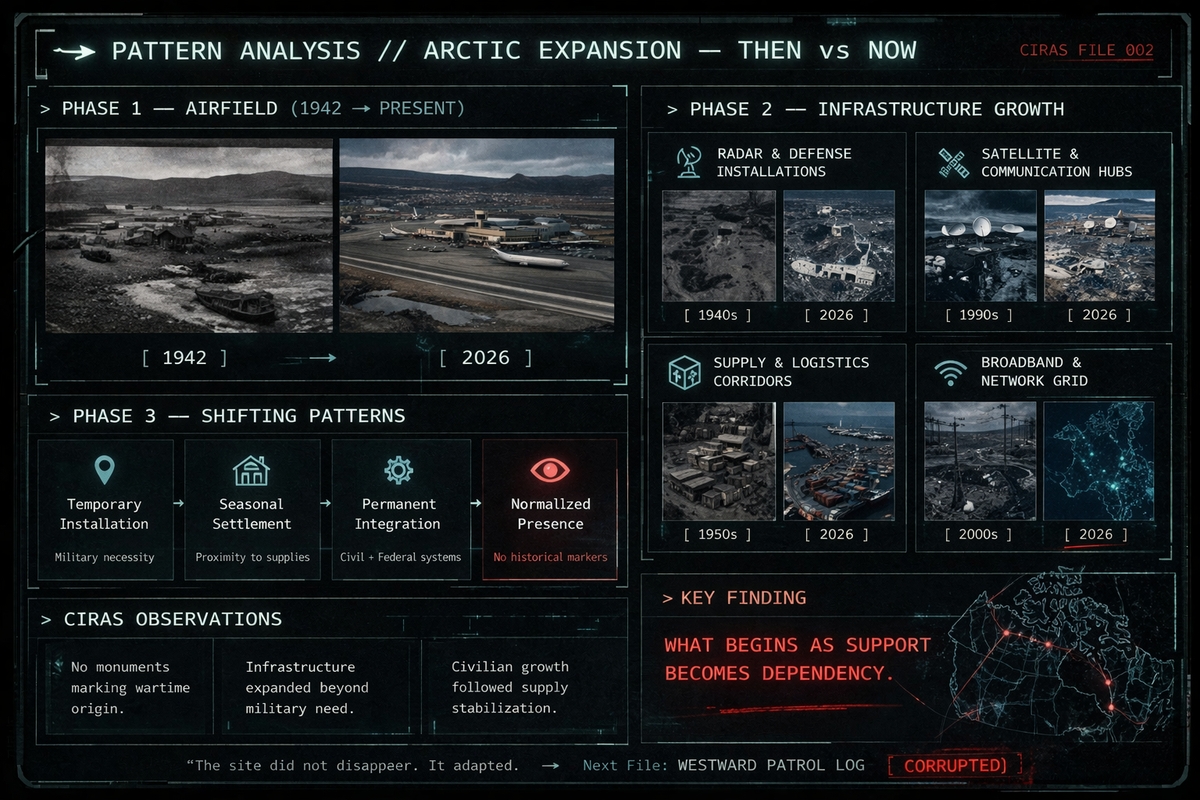
Built as a temporary wartime airfield, Crystal II became something more. As supply routes expanded and settlements formed, the Arctic began to change in ways that were never fully reversed.
CONFIDENTIAL — FILE RETRIEVED FROM CIRAS ARCHIVE
↳ CIRAS FILE ENTRY
> CLASSIFICATION: [ARCHIVE]
> CATEGORY: INFRASTRUCTURE ORIGIN / ARCTIC EXPANSION
> SOURCE: Historical Arctic Engineering Records (Declassified Fragments)
> DATE LOGGED: APR 2026
> FILE: CRYSTAL II — ORIGIN POINT
> EVENT:
Before there was a patrol.
Before there were crates.
Before the routes were mapped—
There was a landing site.
And a decision to stay.
---
> ORIGIN PURPOSE:
> CRYSTAL II was constructed during World War II
> as part of a transatlantic aircraft ferry network.
> Its function:
> - refueling military aircraft
> - enabling rapid deployment between North America and Europe
> - extending operational reach into northern airspace
> The site was selected for its position within a broader Arctic corridor,
> later referred to as part of the “Crimson Route.”
> Initial designation: temporary.
> Actual duration: ongoing.
> Long-term occupation was not listed as an objective.
> It occurred regardless.
---
> The Arctic presented a problem:
> Limited visibility.
> Limited oversight.
> Unlimited access.
> Establishing a fixed position allowed:
> - predictable navigation
> - controlled entry
> - sustained observation
---
> Site selection was not conducted independently.
> Local knowledge was required.
> Terrain understanding was essential.
> Inuit guides assisted in identifying viable landing zones,
> tidal access routes, and seasonal stability patterns.
> These contributions were not formally recorded in operational logs.
---
> Following construction, supply chains were established.
> Fuel.
> Preserved food.
> Imported goods.
> Seasonal movement patterns began to shift.
> Not by force—
> but by proximity.
> Introduced goods altered consumption patterns:
> White sugar.
> Tea.
> Flour.
> Supply dictated availability.
> Availability dictated location.
---
> Medical services were centralized through settlement zones.
> Access remained conditional.
> Patient transfers—particularly for respiratory illness—
> increased across northern regions during mid-century operations.
> Individuals were relocated south for treatment.
> Return records are inconsistent.
> In several documented cases,
> the last confirmed point of contact
> remains the departure.
---
> Federal presence increased alongside infrastructure.
> RCMP patrols expanded into newly stabilized regions.
> Cooperation was often facilitated through:
> - supply access
> - transport priority
> - administrative approval
> Participation was not always voluntary.
---
> While CRYSTAL II remained the primary recorded installation,
> additional survey points appear in fragmented logs.
> These locations were:
> - unlisted
> - unsupported
> - absent from supply chain documentation
> One such designation appears repeatedly:
> ↳ SITE B
> No official record confirms its construction.
---
> By the early 1960s, regional conditions had changed.
> Movement patterns altered.
> Supply routes established.
> External presence normalized.
> Patrols began moving west.
> Some did not return.
---
> NEXT FILE: WESTWARD PATROL LOG
> STATUS:
CORRUPTED