
Splinter View: Chapter 6 — November 17, 2025
CHAPTER 6 — “Wind-Chime Quiet”
I pad back downstairs in semidarkness, letting the cabin keep its hush. Dusk leans long fingers through the blinds, painting the floors in shutter-striped amber. The coffeemaker’s burner clicks off with a tiny sigh—out of caffeine, into herbal. Noise and movement—proof the world’s still mechanical, not mystical. I fill the kettle, set it on the gas ring, and strike a match.
For thirty comforting seconds the world is ordinary: water rising toward a boil, Mika’s nails ticking circles in the living room while she searches for the perfect spot to curl. She chooses the rug facing the deck door—of course—and lies sphinx-style, eyes fixed on the fading rectangle of outside.
It’s almost domestic. For once, I can pretend that solitude feels chosen instead of enforced.
I spoon mint leaves into a mug and wait. Steam begins to whisper from the spout.
CLACK.
CLACK.
CLACK.
Three blows in quick succession—loud enough to vibrate the cabinet doors. I whirl, kettle still in hand. The brass chimes under the eave hang in plain view through the slider: perfectly motionless.
No wind. No sway.
Yet the echo lingers.
Water sloshes onto my wrist, scalding hot. I hiss, set the kettle down too hard.
The hush that follows is worse.
It isn’t silence so much as vacuum.
Mika lifts her head.
Then barks.
Sharp. Certain.
She plants herself between me and the deck door.
Adrenaline fires. I grab for logic.
“Thermal expansion,” I say too quickly. “Metal cooling. Differential strain.”
The words sound rehearsed.
The chimes do not move.
I flip open the notebook.
1902 hours. Triple acoustic event. No wind. Chimes static.
The pen trembles slightly.
The kettle whistles—too loud.
I pour. Watch the mint bloom.
Step to the glass.
The world outside is charcoal.
The hole in the trees darker than everything else.
Nothing moves.
But the air feels… wrong.
Mika’s reflection appears beside mine.
Hackles raised.
Growl low enough to feel in my bones.
I back away.
Everything returns.
The fridge hum.
The house settling.
Normal.
I write again.
Subjective auditory dampening ~20s post-event.
If repeat occurs: initiate recording.
Mika presses against my leg.
I breathe.
Drink the tea.
Mint.
Steel.
Something like pennies.
I ignore it.
Open the laptop.
Create folder:
ANOMALY_LOGS
Queue the mic.
Outside, in the last breath of dusk, the wind chimes hang still.
Silent.
But the deck beneath them dips.
Just slightly.
As if something stands there.
And the wood remembers.
Read more
Splinter View: Chapter 7.5 — November 25, 2025
A sleepless night leads Lena back to one of Rae's abandoned projects. As old data resurfaces, so do the consequences of silence.

Canada Chooses Swedish Surveillance Planes for Arctic Defense Operations
Canada has announced plans to pursue Swedish airborne surveillance platforms for Arctic defense operations, marking a notable shift away from traditional reliance on U.S. systems.
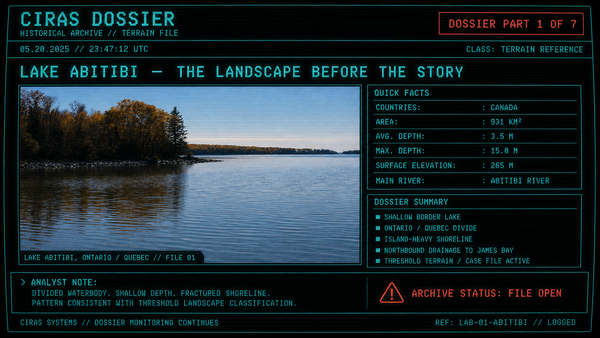
History of Lake Abitibi, Ontario and Quebec: The Landscape Before the Story
Before treaty lines, dams, rail corridors, or extraction records, Lake Abitibi was already a threshold landscape: shallow, island-thick, divided by border and narrows, and tied to a northbound watershed running toward James Bay.
CIRAS Alert: Reactors in the North and Arctic Energy Risk
A new Canadian nuclear strategy raises the possibility of microreactors for remote northern defence sites. CIRAS reviews the real energy case, the historical warning, and the anomaly risk.